Why AI Answers Sound Generic: You Get the Likely Answer
With Josh Schultz ·
Answer. AI answers sound generic because you get predictable output (the answer most people would get). It looks clean and finished, but it is the same answer your competitor gets when they ask the same question. To get a better one, give the AI what only you know.
The picture
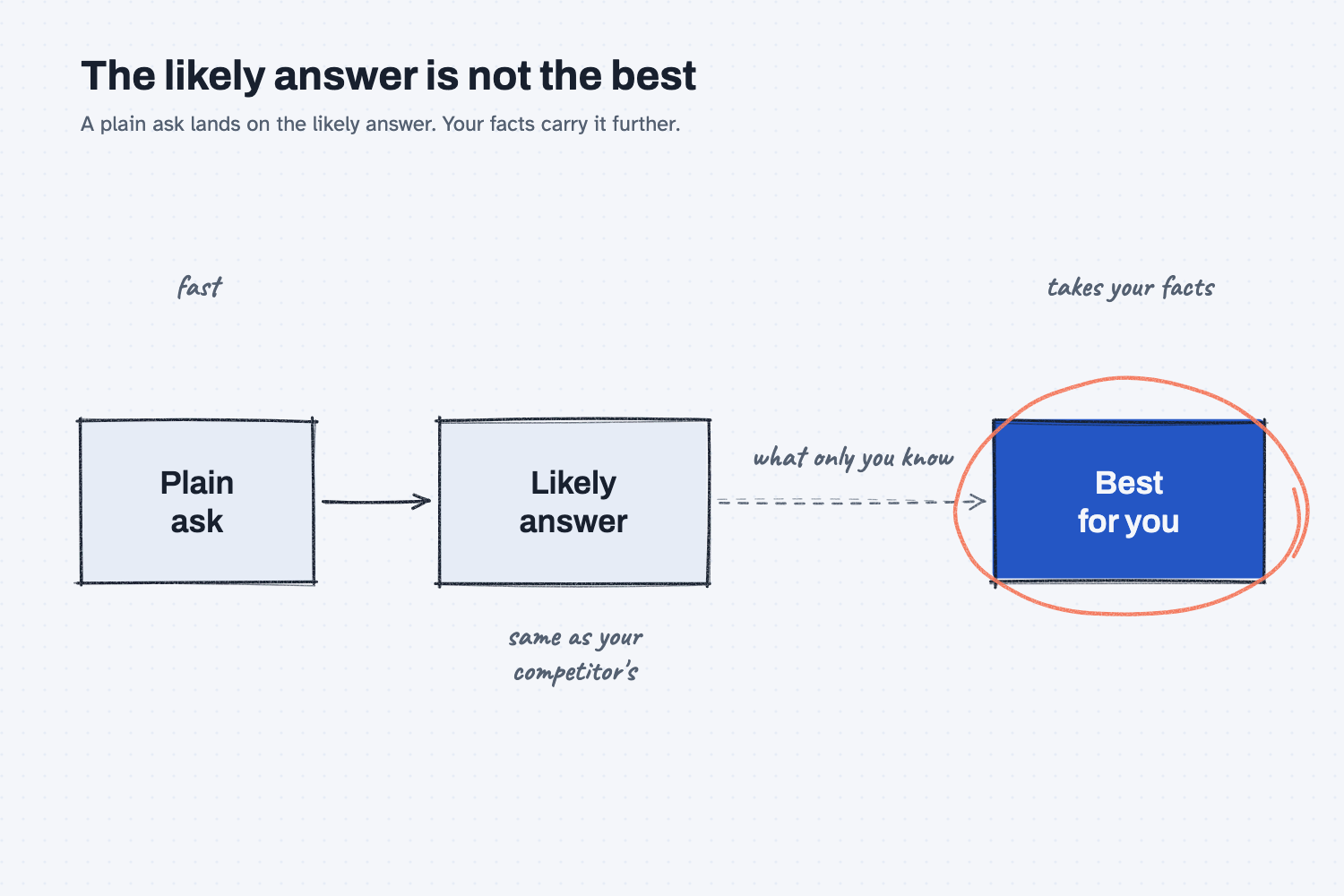
Start at the left of the line, where a plain ask lands quickly on the likely answer, which is the same one your competitor would get. Most people stop there. The best answer for your shop sits much further to the right, and the long dashed gap between the two is labeled "what only you know." The only way to cross that gap is to bring in what the AI can't know on its own.
Think of it like this
Think about ordering a part from a catalog. You need a bracket, so you order the one in the catalog, which fits most machines, ships fast, and looks right.
But your competitor ordered the same bracket, and it doesn't quite fit your machine, because your machine has a quirk nobody wrote down.
A first AI answer is the catalog part, because it is built to fit most cases. A custom part needs your measurements, and the AI does not have them until you hand them over.
Why does it matter at work?
A clean answer looks finished, so people use it. A generic plan can quietly cost you money, because it fits the average business and not yours.
Here is how I put it in my field notes: "Predictable is what you want from a routine workflow. For a strategy, predictable is what your competitors got too."
Here is how that plays out. Carol Whitaker runs Mesquite Ridge Metal Works, and she asks AI for a pricing plan for the RidgeLine pump controller. She gets four neat price tiers with volume discounts, and it reads great.
But her six dealers don't pick RidgeLine on price. They pick it for fast warranty fixes, so a volume discount would give money away to dealers who would happily pay full price. The plan wasn't wrong for "a company," but it was wrong for hers. Once she adds what she knows, the answer starts to fit.
How does it work?
AI is built to produce what is likely, and three things follow from that.
It always answers. It won't stop and say "I don't have a good idea here." In my notes: "AI is forced to give you an answer, and the answer it gave you is the most predictable one." If you want to see why, the lesson on how AI writes one word at a time shows the guessing underneath.
Other AI tools land in the same spot. Research has found that answers from different AI models are far more alike than answers from different people, and asking them to "be more creative" helped little. So switching tools does not fix the problem.
Your facts move the answer. The AI has read what everyone knows, but it hasn't read your customers, your numbers, or your history. When you add those, it has something to work with besides the average.
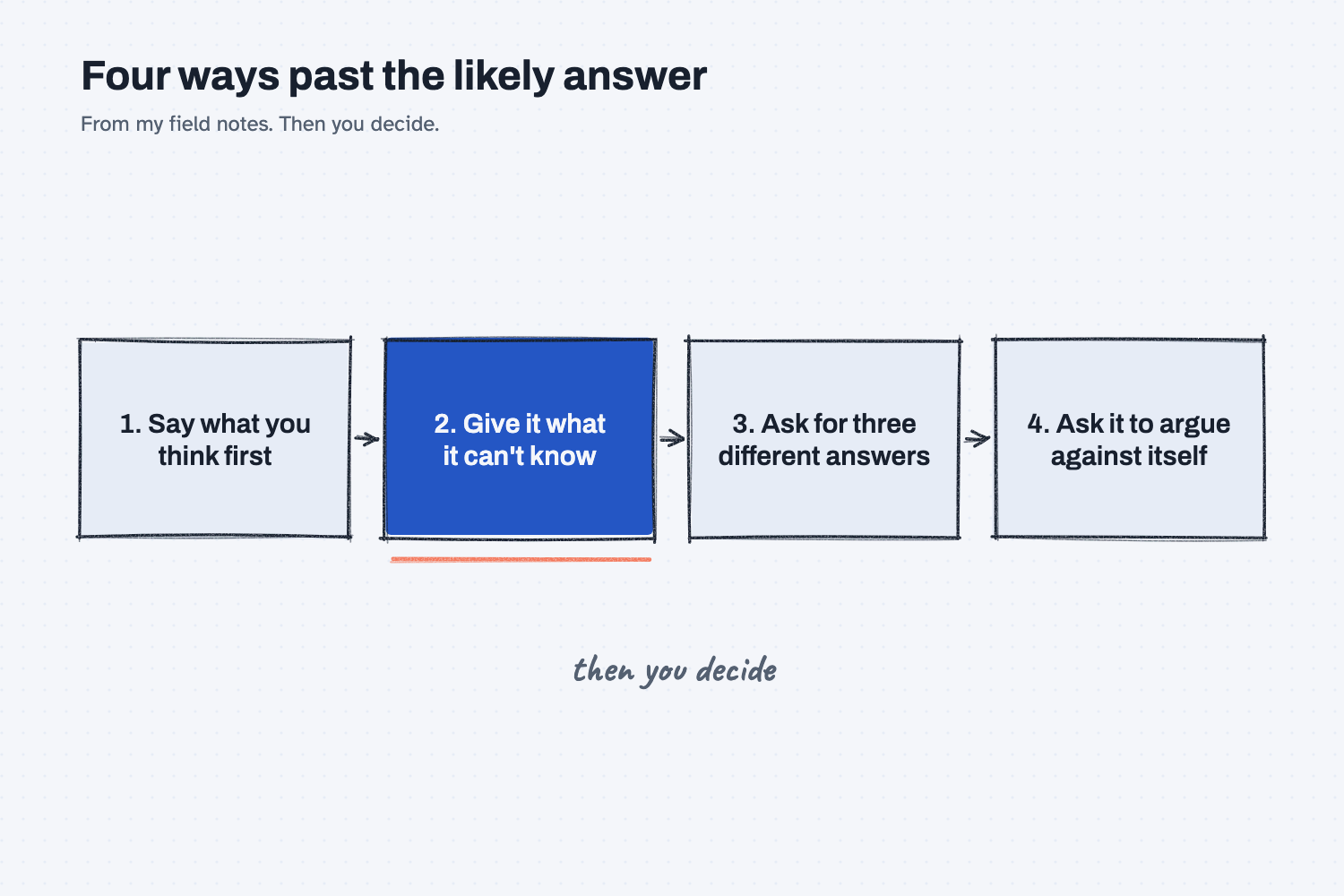
The second picture lists four steps for getting past the likely answer. First say what you think, then give the AI what it can't know, then ask for three different answers, and then ask it to argue against itself. After that you decide for yourself. Keep in mind that predictable is not always bad, because for routine work like matching an invoice, predictable is exactly what you want.
Where do people get it wrong?
Most mistakes come from trusting how the answer sounds. These are four I would watch for.
- Taking the first answer because it reads well. In my notes: "Sounding right is what predictable answers do."
- Asking harder instead of adding facts. "Be more creative" barely moves the answer, while one fact about your customers moves it a lot.
- Switching tools to fix it. A different AI tends to give a very similar answer, so the fix is what you bring, not which tool you open.
- Thinking unusual means better. Different is not the same as better, because you want the best answer for your shop and not a strange one.
Try this in 2 minutes
This test shows you the likely answer with your own eyes. Use any chat tool.
- Open a new chat and paste this:
Give me a pricing plan for a small company that sells irrigation pump controllers to farm supply dealers. Answer in 4 short bullets.
- Open one or two more new chats and paste the same thing, then put the answers side by side.
- Open one more new chat and paste the same question, plus what only you know:
Give me a pricing plan for a small company that sells irrigation pump controllers to farm supply dealers. Answer in 4 short bullets.
What only we know:
- Our 6 dealers buy before spring planting and pay on time.
- They pick us for fast warranty fixes, not for price.
- Our cost on the control board went up 9% this year.
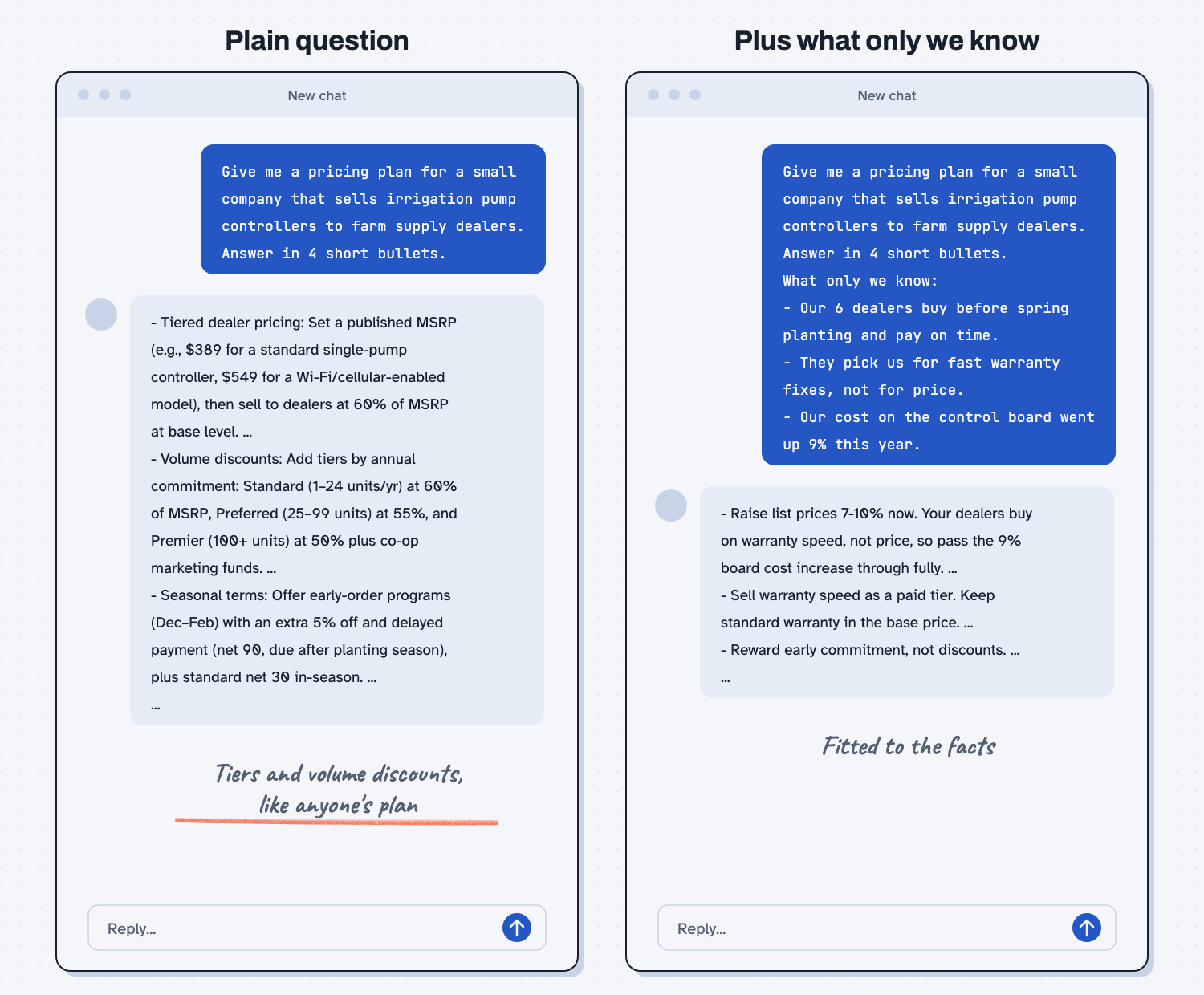
When I tried the plain question, the answer led with "Tiered dealer pricing," then "Volume discounts," then "Seasonal terms." It was a fair plan for any company that sells to dealers. If you ask again, you get the same kind of plan with different numbers. One answer said "Add tiers by annual commitment: Standard (1–24 units/yr) at 60% of MSRP, Preferred (25–99 units) at 55%." Another said the same thing with other percents.
With the three facts, the plan changed. It opened with "Raise list prices 7-10% now. Your dealers buy on warranty speed, not price, so pass the 9% board cost increase through fully." Then it sold the thing the dealers value: "Sell warranty speed as a paid tier."
That is better, and it fits our business, but it is not done. It still suggested an early-order discount, even though our dealers already buy early and pay on time, which is why you still read the answer yourself. Next time, swap in your own facts.
Frequently asked questions
Is a generic answer a wrong answer?
No. It is often right in general, but it isn't fitted to you. For routine work that is fine. For a plan or a decision, it is where you start, not where you stop.
Will a better prompt fix it?
Partly. Better wording helps a little, but facts only you know help most, such as your customers, your numbers, and your history. That is also why AI multiplies what you already know.
Why did two AI tools give me almost the same answer?
They learned from much of the same writing, and they are built to produce the likely answer. Research has found that different AI models answer far more alike than different people do.
When is the predictable answer okay to use?
For routine work such as an invoice match, a standard reply, or a formula. Push past it when an average answer would cost you real money or trust.
Use it today
- Related idea: How AI writes one word at a time: why the average answer comes first.
From my training: this comes from two of my field notes, "AI Exaggerates" and "Best, Not Predictable."