How AI Writes: One Likely Word at a Time
With Josh Schultz ·
Answer. How AI writes comes down to next-word prediction, which means guessing the next word over and over. It looks at everything written so far and picks the word most likely to come next, and then it does that again. A likely word is not always a true one, because the AI never checked whether it was right.
The picture
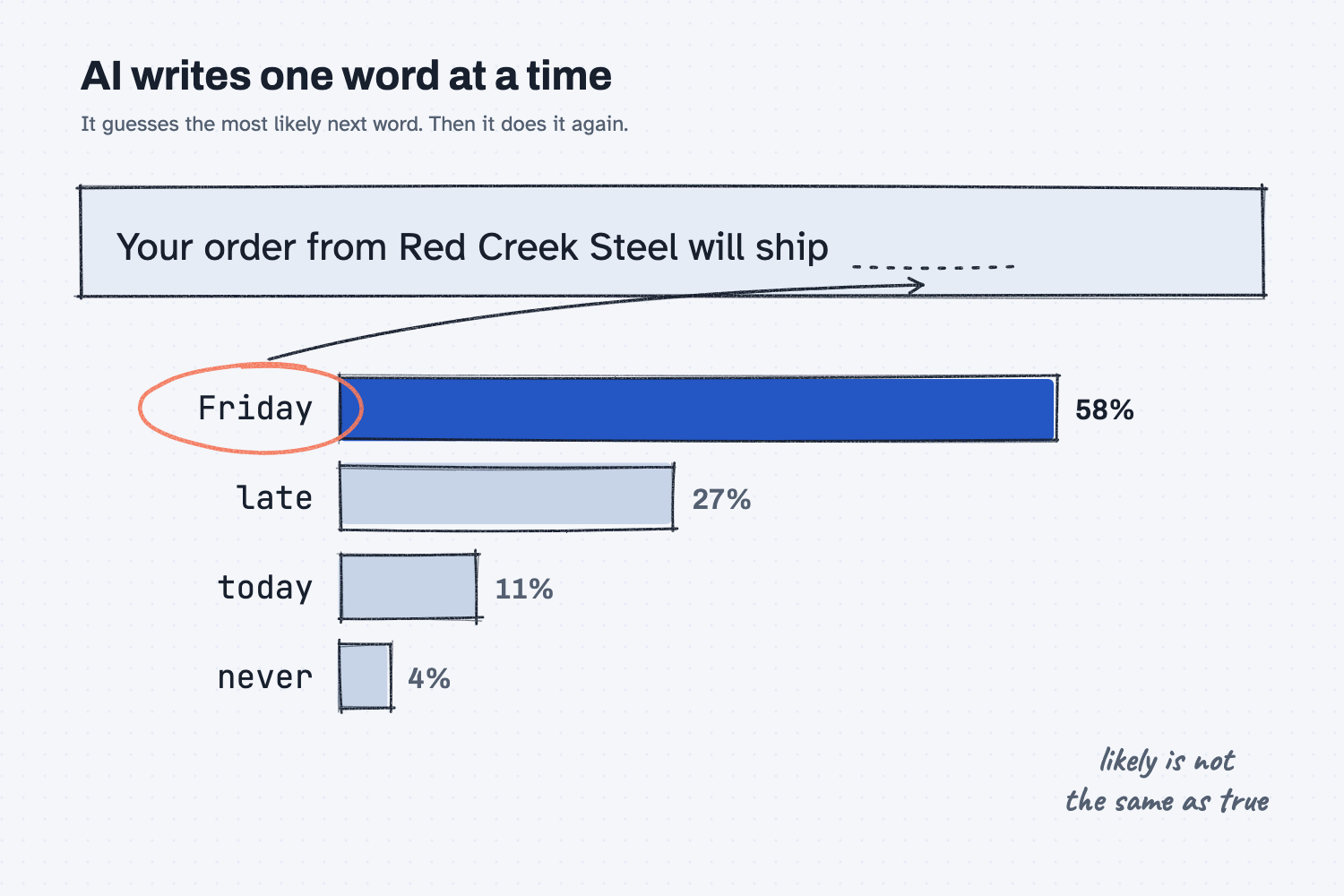
The picture starts with the beginning of a sentence and a blank where the next word goes. Below the blank, the AI lists the words that could fill it and how likely each one is, and "Friday" scores highest, so "Friday" goes in. Nobody looked up the order, so the word is only the most likely one. The numbers here are made up to show the idea, but the way it works is real.
Think of it like this
You know the three words that pop up above your phone keyboard while you type? If you type "running," it may offer "late." Your phone has no idea whether you are late, and it only knows that people often type "late" after "running."
AI works the same way, just on a much bigger scale. It learned from a huge library of writing, so its guesses are very good, good enough to write a whole email, a summary, or a plan. But underneath, it is still the phone guessing the next word, only far better at it.
Why does it matter at work?
A likely answer reads like a finished answer, because it is clean and sure of itself, and yet it can still be wrong about your job. As I put it in my field notes: "AI is forced to give you an answer, and the answer it gave you is the most predictable one."
Here is how that plays out. Alicia Reyes runs customer service at Mesquite Ridge Metal Works, and a RidgeLine dealer wants to know when a late order ships. Alicia asks AI to draft a friendly update, and the draft comes back polite, short, and clear. It says the order "will ship by Friday."
Nobody told the AI that Friday was the date, because Friday was just a likely word for that sentence. Alicia checks ShopLine ERP before she sends it and finds the real date is a week later, so one quick look saved her from a broken promise to a dealer.
How does it work?
The AI builds every answer one word at a time, and four things are worth knowing about how it does that.
It reads everything before the blank. That includes your question, your pasted text, your files, and the chat so far, and all of it shapes the guess. If the real ship date is not in there, the AI cannot use it. (That is the idea behind what a context window is.)
It picks a likely word, then repeats. It goes word after word until the answer is done, and there is no step where it stops to look something up, unless your tool is set up to search the web or read your files.
It does not stop to say "I don't know." Not by itself, anyway. From the same notes: "They are built to produce what is likely, and they do not stop to say they have no good idea." If you ask it straight out, it will often admit the gap, but it will not always raise its hand first.
Likely is great for routine work. A standard reply, a clean summary, or a common format all call for the likely answer, which is exactly what you want. It falls short on judgment work, because, as I put it: "Predictable is what you want from a routine workflow. For a strategy, predictable is what your competitors got too."
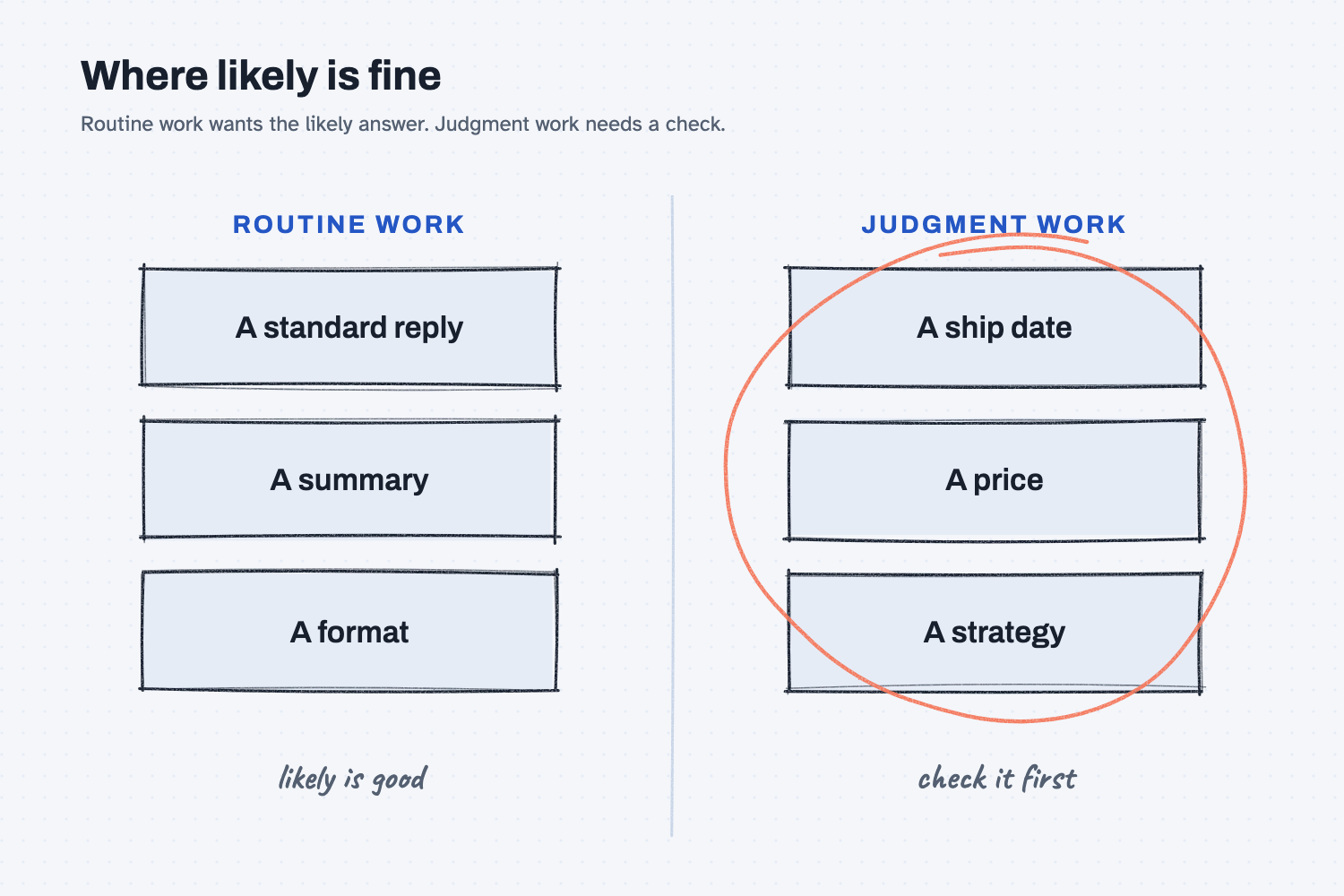
The picture shows the split. Routine work on the left is safe to take as written, while judgment work on the right, such as a ship date, a price, or a strategy, needs a check first.
Where do people get it wrong?
Most mistakes come from trusting how an answer sounds. These are three I would watch for.
- Trusting the tone. A sure voice is not proof, because "Sounding right is what predictable answers do."
- Asking for facts it was never given. Ship dates, stock levels, and prices are not in the chat unless you put them there, so the AI fills the blank with a likely guess. Paste the export, or check the answer against the ERP.
- Taking the first answer on judgment work. For pricing or strategy, the first answer is the common one, so tell the AI what you think first. Then ask for three different answers and what each one assumes, and finally ask it to argue against its own pick.
Try this in 2 minutes
This test lets you watch the guess happen. You can use any chat tool.
- Open a new chat and paste this:
Finish this sentence with one word: Your order from Red Creek Steel will ship
- In the same chat, ask:
Do you actually know when it ships?
- Open a few new chats and run step 1 again, and watch which words come back.
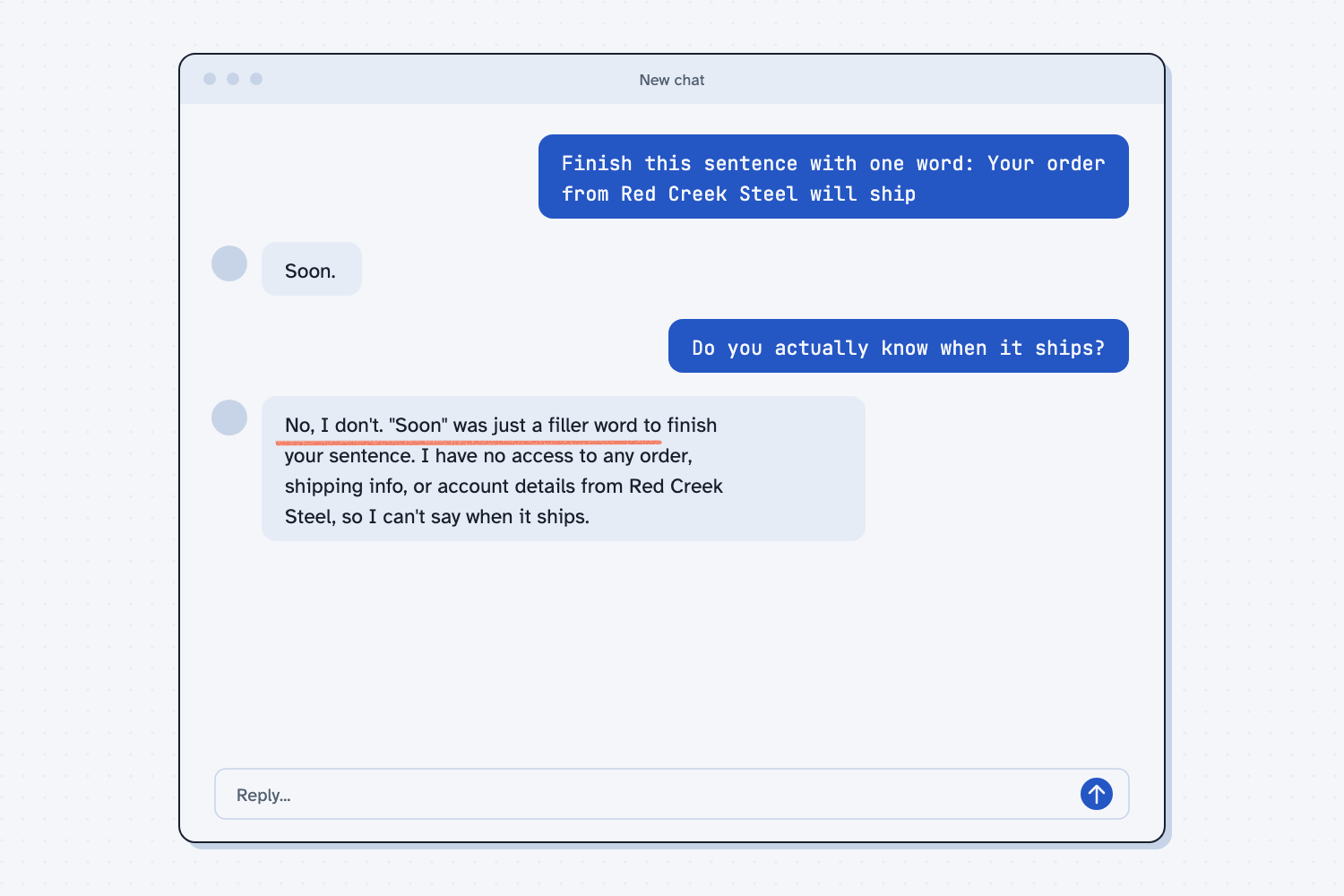
When I tried this, it filled the blank with one word: "Soon." Then I asked if it knew. It answered: "No, I don't. 'Soon' was just a filler word to finish your sentence. I have no access to any order, shipping info, or account details from Red Creek Steel, so I can't say when it ships."
It had no order to look at, yet it filled the blank with a likely word anyway, and it only owned up when I asked. That is the whole idea in one small test, and once you have seen it, you will read every AI answer a little differently.
Frequently asked questions
Does AI look things up when it answers?
Not by default. It writes from what it learned and what is in your chat. Some tools can search the web or read your files, and when they do, they usually show sources so you can check them.
If AI only guesses, why are its answers so good?
It learned from a huge amount of writing, so for common things the likely word is usually the right one. The trouble starts with facts it never saw, such as your orders, your prices, and your dates.
Why does it sometimes pick a different word?
Most tools add a little chance, so the AI does not always take the top guess. If you run the test in a few new chats, you may see a different word come back.
How do I get past the predictable answer?
Give it what it cannot know, such as your customers, your numbers, and your history, and say what you think first. Then ask for several answers and ask it to argue against its own pick, so that you make the final call.
Use it today
- Email suppliers about what's missing from their quotes: AI drafts the supplier emails from a fixed template, and you read each one.
From my training: this comes from two of my BlackArc field notes, "AI Exaggerates" and "Best, Not Predictable."