What Does Deterministic Mean in AI? Push the Work Down to a Script
With Josh Schultz ·
Answer. Deterministic means same input, same answer, every time. A script (a small saved program) is deterministic. AI is not. So for work that must repeat, use AI only for the messy part, like reading a quote PDF. Then push the rest down to a script.
The picture
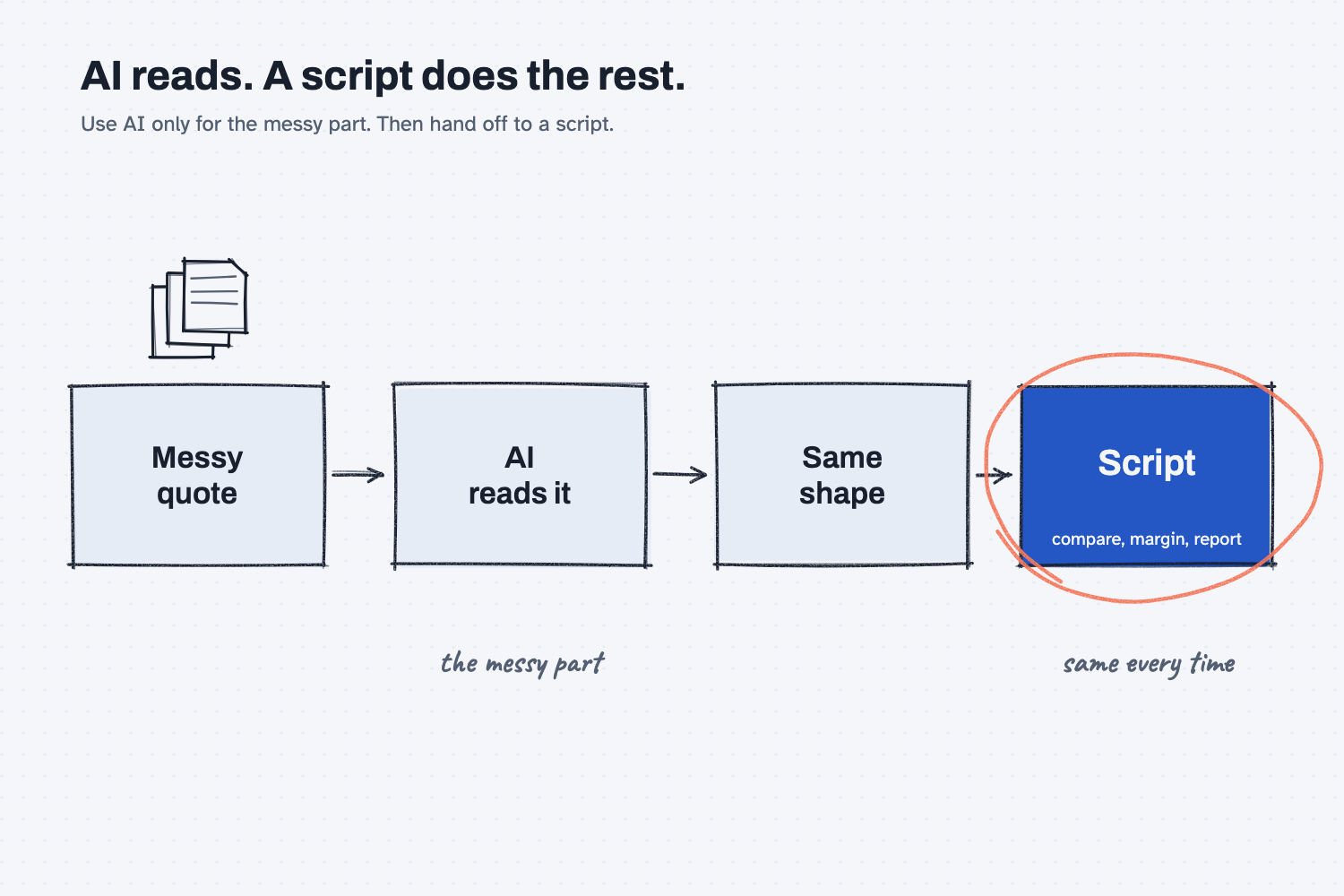
Read it left to right. AI reads the messy file and puts what it finds into the same shape. Then a script takes over. The script is circled because it does most of the work.
Think of it like this
You already use the best example of this every day. It's an Excel formula.
Type =B2*1.2 in a cell, and it adds 20 percent to whatever is in B2. It does it in a blink. It does it the same way on row 2 and on row 2,000. It costs nothing to run.
But put the words "call for price" in B2, and the formula breaks. It shows an error. It has no judgment to work around the problem.
AI is the opposite. It has judgment. It can read "call for price" and know what it means. But ask it the same thing twice, and you may get two different answers.
So we use each one for what it's good at. AI reads the mess. The formula, or a script, does the math.
Why does it matter at work?
It matters because work you do every week has to come out the same every week. AI doesn't do that on its own.
Here's how that plays out. Dana Ortiz is the senior buyer at Mesquite Ridge Metal Works. Every month she compares steel quotes from Red Creek Steel Supply and Panhandle Bar and Plate. She drops the quotes into a chat and asks AI to build the comparison page.
It works. But every month the page looks different. One month the lead times are in a column. The next month they're in a sentence. Luis, the controller, can never find the margin line in the same spot.
So Dana splits the job. AI reads each quote and fills in the same blank form. A script turns those forms into the comparison page. Now the page looks the same every month. When Luis asks for a margin check at the bottom, she adds it to the template once. It's there every month after that.
How does it work?
You split the job at the point where the mess ends. AI goes before that point. Scripts go after it.
AI takes the fuzzy part. A quote can arrive as a PDF, a spreadsheet, or a screenshot of a web page. Reading that takes judgment, so AI does it. Its only job is to put what it finds into the same shape every time. The lesson on structured output shows how.
Scripts take the repeat part. Compare prices. Add margin. Build the report page. These steps have clear rules. A script follows the rules the same way every time, and it uses no tokens (what you pay AI for).
The report comes from a template, not from AI. If AI builds the page each time, it comes out different each time. We're never going to be able to control it. It's not going to be repeatable. A template filled by a script looks the same every run. You can improve it over time, one change at a time.
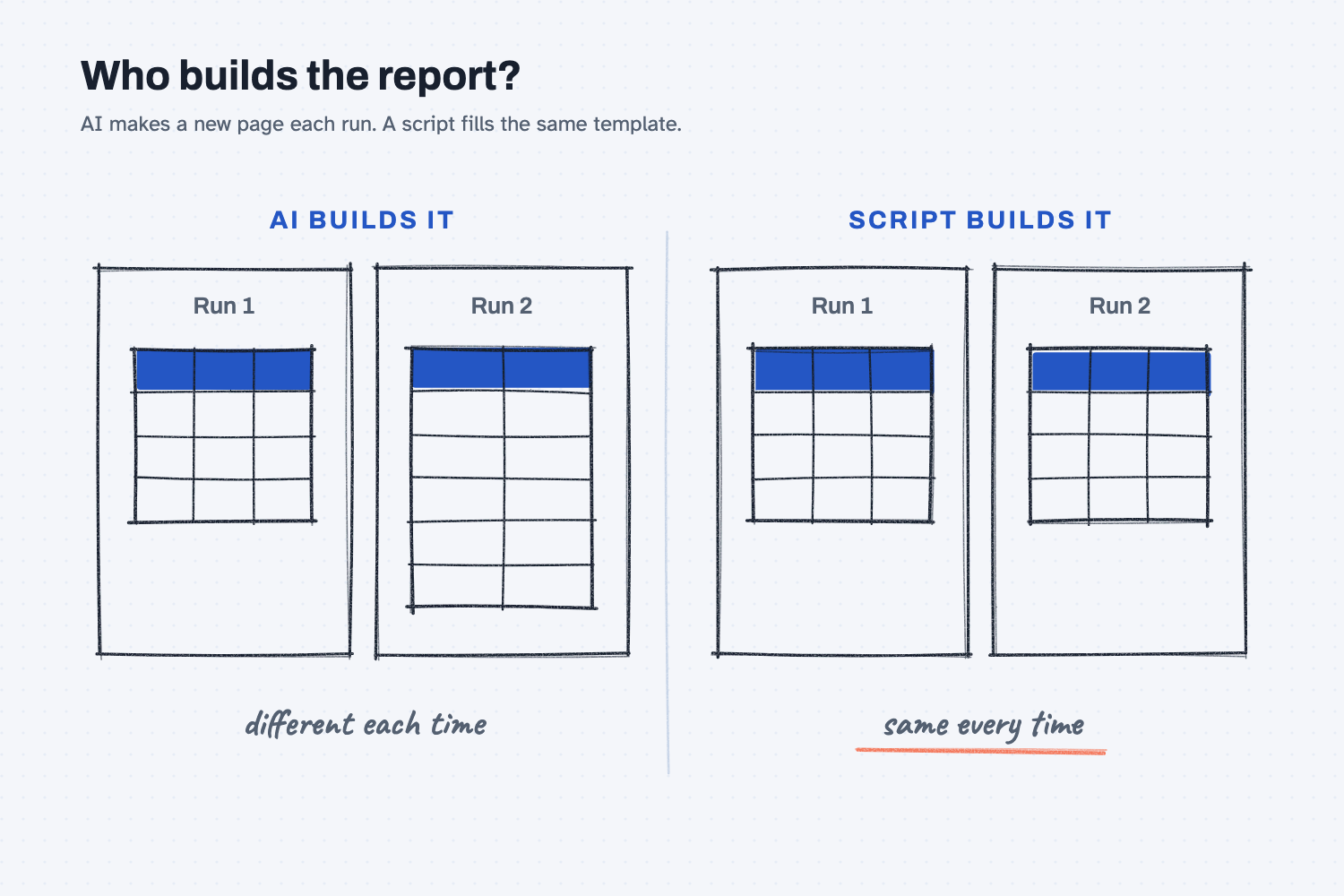
Why bother? A script is faster and cheaper. It uses no AI. It's more reliable, and it gives you the same thing every single time. So wherever possible, we actually don't want to use AI.
How do I know which steps go to a script?
Ask one question about each step: does it need judgment, or does it follow a rule?
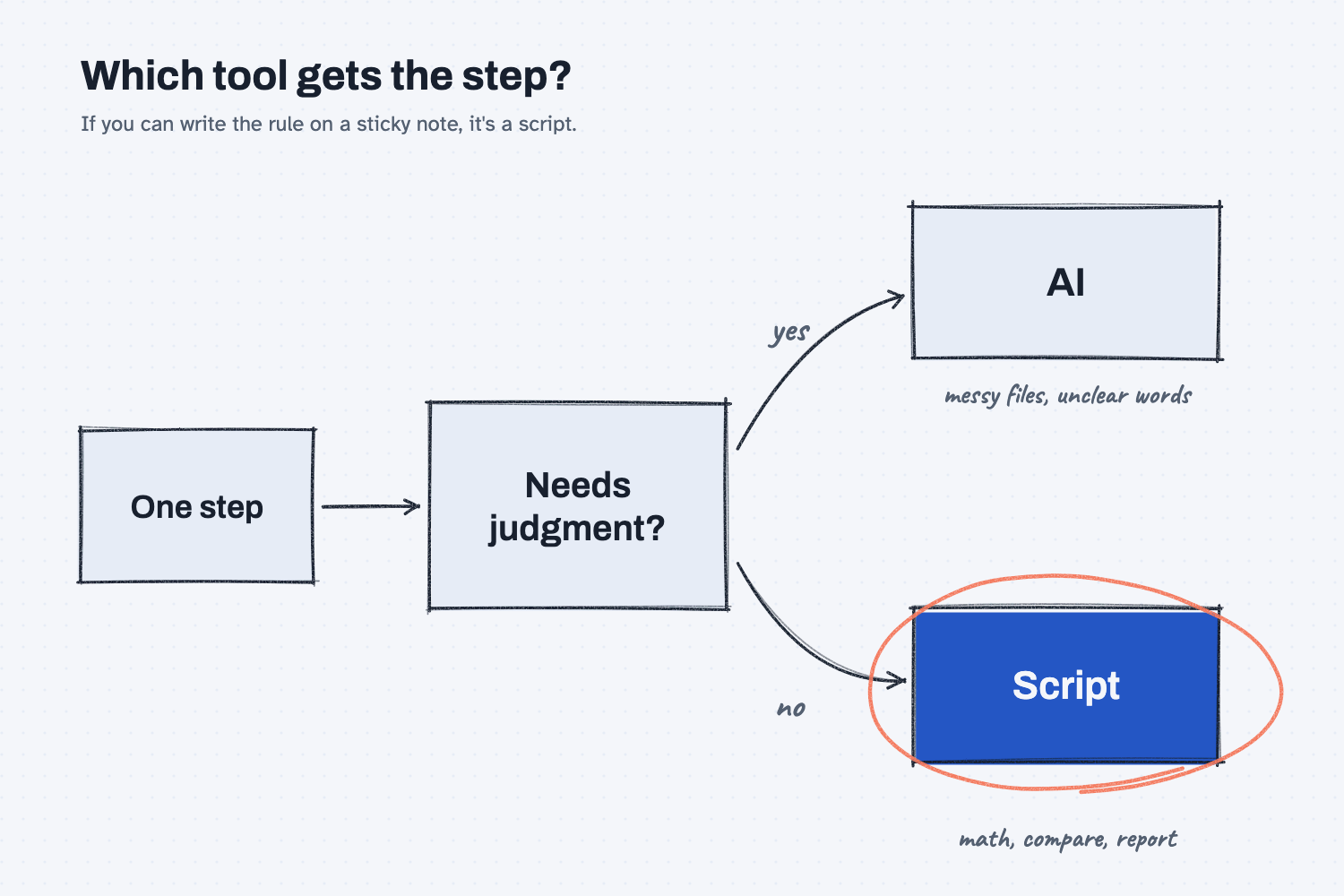
If you could write the rule on a sticky note, it goes to a script. "Add 20 percent." "Sort by lowest price." "Flag any lead time over 30 days." If you'd have to say "it depends," it goes to AI.
Where do people get it wrong?
Most mistakes come from letting AI do every step because it can.
- Asking AI to do the math. AI can add a column. But a formula adds it the same way every time, for free. Ask AI for the formula, not the answer.
- Asking AI to build the same report every week. You get a new layout every week. Build the template once and let a script fill it.
- Feeding a script messy data. A script breaks like the formula did on "call for price." Have AI clean and shape the data first. That's the hand-off point.
- Thinking "no AI" means "the old way." The script is the upgrade. AI gets you to the point where a script can take over.
Try this in 2 minutes
This test shows the difference between AI writing a report and a formula doing the math. Use any chat tool and Excel.
- Open a new chat. Paste this:
Here are two quotes for 4140 steel bar stock, 2 in. round (part MR-3001).
Red Creek Steel Supply: $4.10 per foot. Lead time 3 weeks. Net 30.
Panhandle Bar and Plate: $3.85 per foot. Lead time 6 weeks. Net 45.
Write a short comparison report. Add a 20 percent margin to each price.
- Open a second new chat. Paste the exact same thing.
- Put the two reports side by side. Look at the layout, the order, and the wording.
- Now open Excel. Put
4.10in B2 and3.85in B3. In C2, type=B2*1.2. Copy it down to C3.
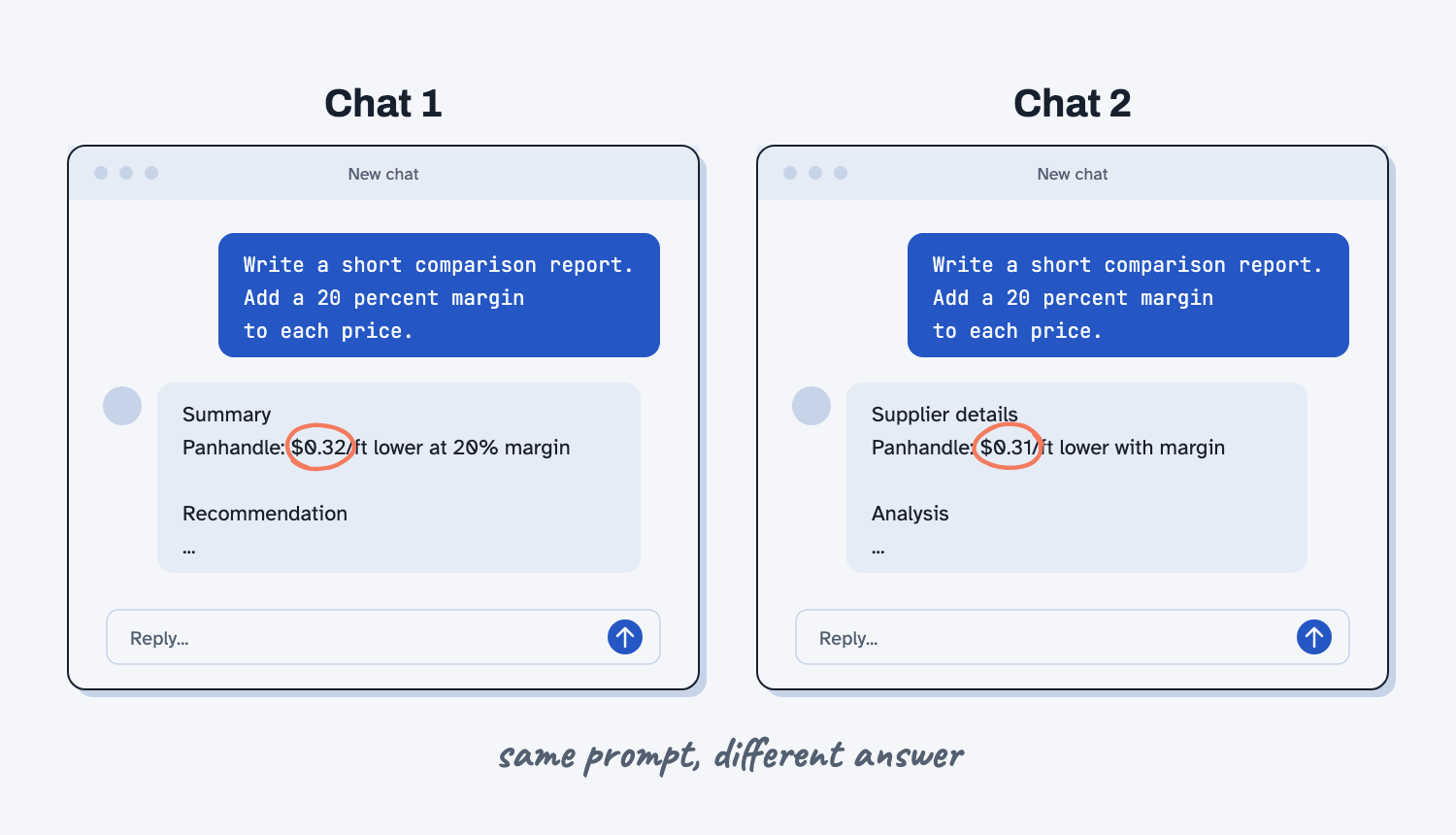
Here is what happened when I ran it in GPT-5 on Nov 19, 2026. Same prompt, two new chats.
- The layout changed. Run 1 had "Summary" and "Recommendation" sections. Run 2 had "Supplier details" and "Analysis."
- The math changed. Run 1 said Panhandle was $0.32 a foot cheaper after margin. Run 2 said $0.31. Same prices, same ask.
- AI picked a meaning for you. Both runs read "20 percent margin" as gross margin: $4.10 became $5.13. Your formula does a 20 percent markup: $4.10 becomes $4.92. Neither is wrong. But the formula does exactly what you wrote, every time. The chat decided for you, and could decide differently next time.
The formula gives the same answer every time you open the file. That's the whole idea. Let AI do the reading. Let the formula do the part that must not change.
Frequently asked questions
Is AI deterministic?
No. Ask it the same question twice and the wording, the order, or even the answer can change. That's fine for a first draft. It's a problem for a report you run every month.
Do I need to know how to code to use scripts?
No. You can ask AI to write the script or formula for you, once. Test it on a few rows you already know the answer to. After that, the script runs on its own and uses no AI.
Isn't AI good enough to do it all now?
It can do a lot. But "can" isn't the test. The test is: will it do it the same way next month, for free, in a blink? For rule-based steps, a script wins every time.
Is this the same as using a template?
A template is one kind of script work. AI fills in the data. The template decides how the page looks. That way the page looks the same every time, and you control every change.
Use it today
- Email suppliers about what's missing from their quotes: a script picks the asks, so you get the same list every time.
- Have Claude build your quote report: the script gives the same page every time you run it.
- Compare supplier quotes with Claude: AI reads the quotes, and a fixed format does the comparing.
- How to normalize supplier quotes with AI: Claude fills one quote shape, and a free page does the math and flags missing terms.
From my training: "push it down to a script" is one of the ideas we come back to most in my sessions.