Types of AI Explained: Not Every AI Job Is a Chat
With Josh Schultz ·
Answer. The types of AI go well past chat. Chat AI (a language model: AI that reads and writes words) is great with words, while other kinds of AI see, predict, simulate, and plan. They run camera checks, forecasts, what-if runs, and schedules, so use chat AI for words and the right specialist for numbers and plans.
The picture
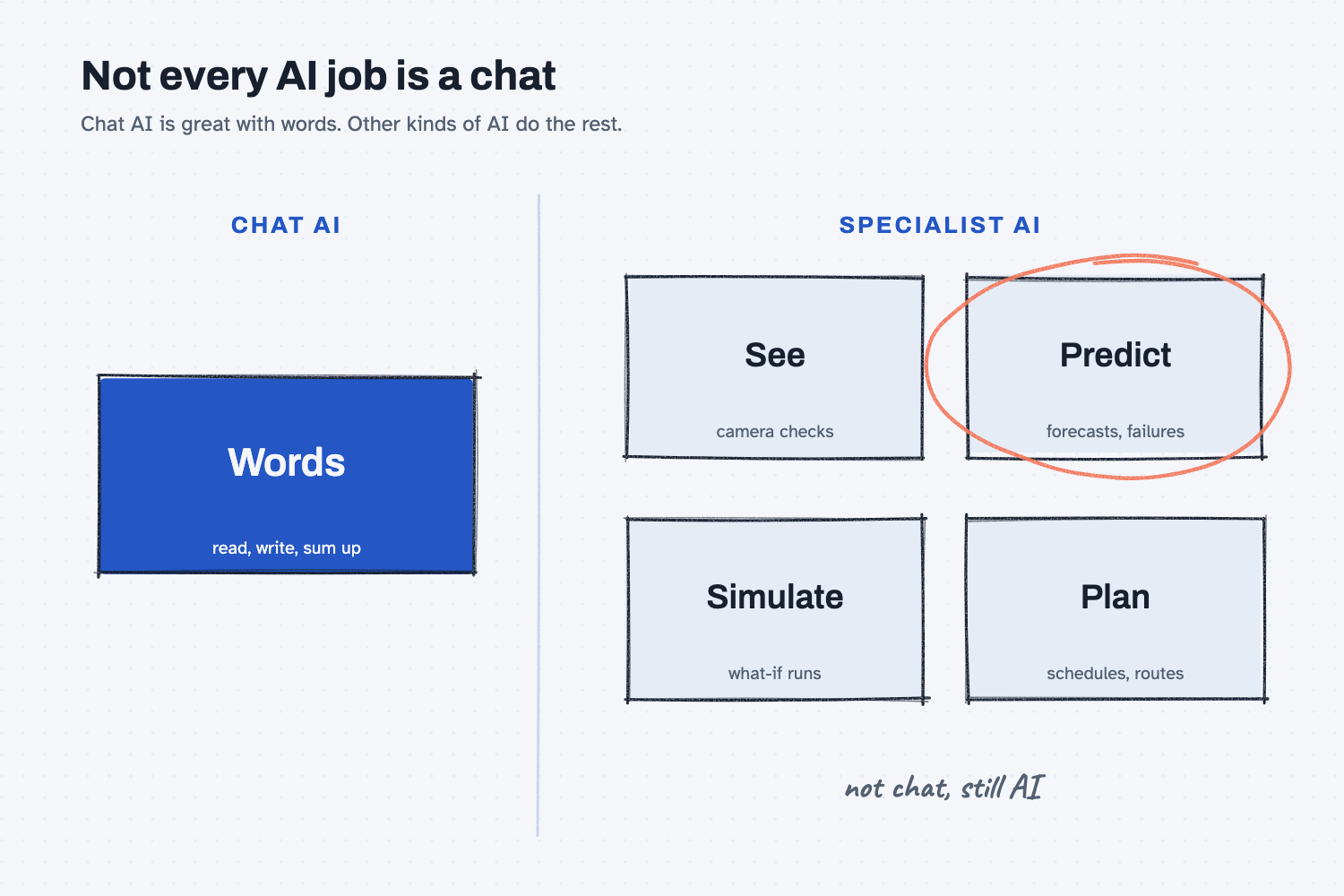
On the left is the AI most people know, the chat box, which is good at reading, writing, and summing up. On the right are four other kinds of AI that do not chat at all: one that sees, one that predicts, one that simulates, and one that plans. They do jobs a chat box handles poorly, and "predict" is circled because forecasting is the job people most often hand to chat by mistake.
Think of it like this
Walk your shop floor and you will find a welder, a press brake, a CNC mill, and a CMM, which is the machine that measures parts.
The welder is great, and you use it every day. But you would never check a part's size with it, because that is the CMM's job.
Chat AI is your welder. It is the one everyone uses, and it is very good at its job, which is words, such as emails, summaries, drafts, and explanations.
But a forecast is not words. It is a number worked out from past data. A schedule is the best plan that fits within your limits, and a camera check is a picture. Those jobs belong on other machines.
Why does it matter at work?
A chat box will try any job you hand it. It will give you a forecast if you ask, and it will sound sure of itself, even though it is not built for numbers. The forecast can look fine and still be hard to check.
Here is how that plays out at Mesquite Ridge Metal Works. Hector Lee, the planner, pastes 12 months of RidgeLine dealer orders into a chat and asks for the next three months. Back come clean numbers with a neat explanation.
The numbers look fine, but Hector can't see how they were made, and he can't check them the way he can check a spreadsheet. If he asks the chat again, the numbers shift. If he plans a whole quarter of steel buying on them, a small miss becomes an expensive one.
The fix was not a better prompt. It was a different tool. Excel has a built-in statistical forecast, so Hector runs that on the same data and then uses chat AI to explain the result in plain words for the morning meeting.
How does it work?
Each kind of AI is built for one shape of job. As I put it in my field notes about these specialist tools: "These are not language models, but they are still AI."
See. This is AI that finds things in pictures, sound, or sensor signals, such as a camera at the end of the line that spots a bad weld, or a sensor that hears a bearing going bad.
Predict. This is AI that learns from past numbers to guess the next one, as in a demand forecast or an estimate of the time until a machine fails.
Simulate. This is AI that runs a pretend version of your plant forward in time, so you can ask "What if we add a second shift on the mill?" before you spend anything.
Plan. This is AI that finds the best plan under limits, such as the best schedule for the CNC cells or the best truck routes. It is math, not words.
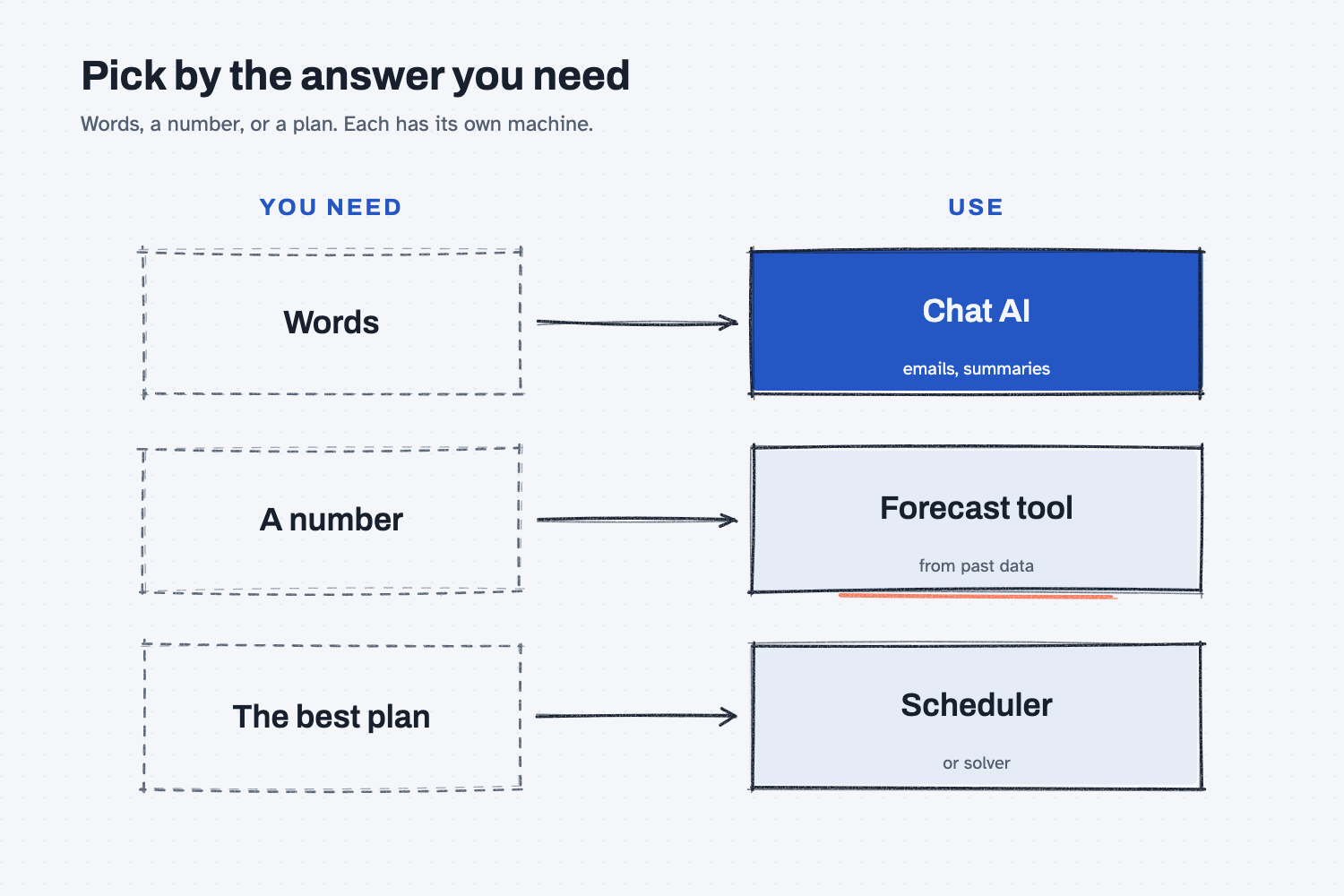
The second picture gives you a simple way to choose. Ask what kind of answer you need, then pick the tool that fits. If you need words, use chat AI. If you need a number from past data, use a forecast tool, and if you need the best plan, use a scheduler or solver.
So where does chat AI fit? It works around the edges, where it can explain a forecast, write the Excel formula, or turn a schedule into an email. My field note on automation puts the forecast part bluntly: "a logistic regression beats a chat completion at predicting a number, every time." In plain words, a simple number model beats a chatbot's answer at predicting a number.
Where do people get it wrong?
Most mistakes come from asking the welder to measure the part. These are four I would watch for.
- Asking chat for a forecast and using it. Ask chat to help you set up a real forecast instead, and then use the forecast tool's numbers.
- Thinking "AI" means "chatbot." When a vendor says "AI scheduling," ask what kind of AI it is, because a solver and a chat box are very different machines.
- Trusting neat math in a chat. The steps look tidy, so people don't check them, but you should check the inputs it used first.
- Not using chat at all for number jobs. Chat is still great for the words around the numbers, such as setting up the sheet, explaining the result, and writing the update.
Try this in 2 minutes
This test shows what happens when you hand a number job to a chat. Open a new chat in any tool and paste this:
Here are monthly dealer orders for our RL-200 pump controller, December to November:
40, 55, 120, 180, 150, 70, 35, 30, 28, 33, 38, 45
Forecast December, January, and February. Then answer in one line: is a chat tool the right tool for this job, and what would you use instead?
Check which months it says it used. Then compare its February to last February (120). Finally, ask the same thing again and see what moves.
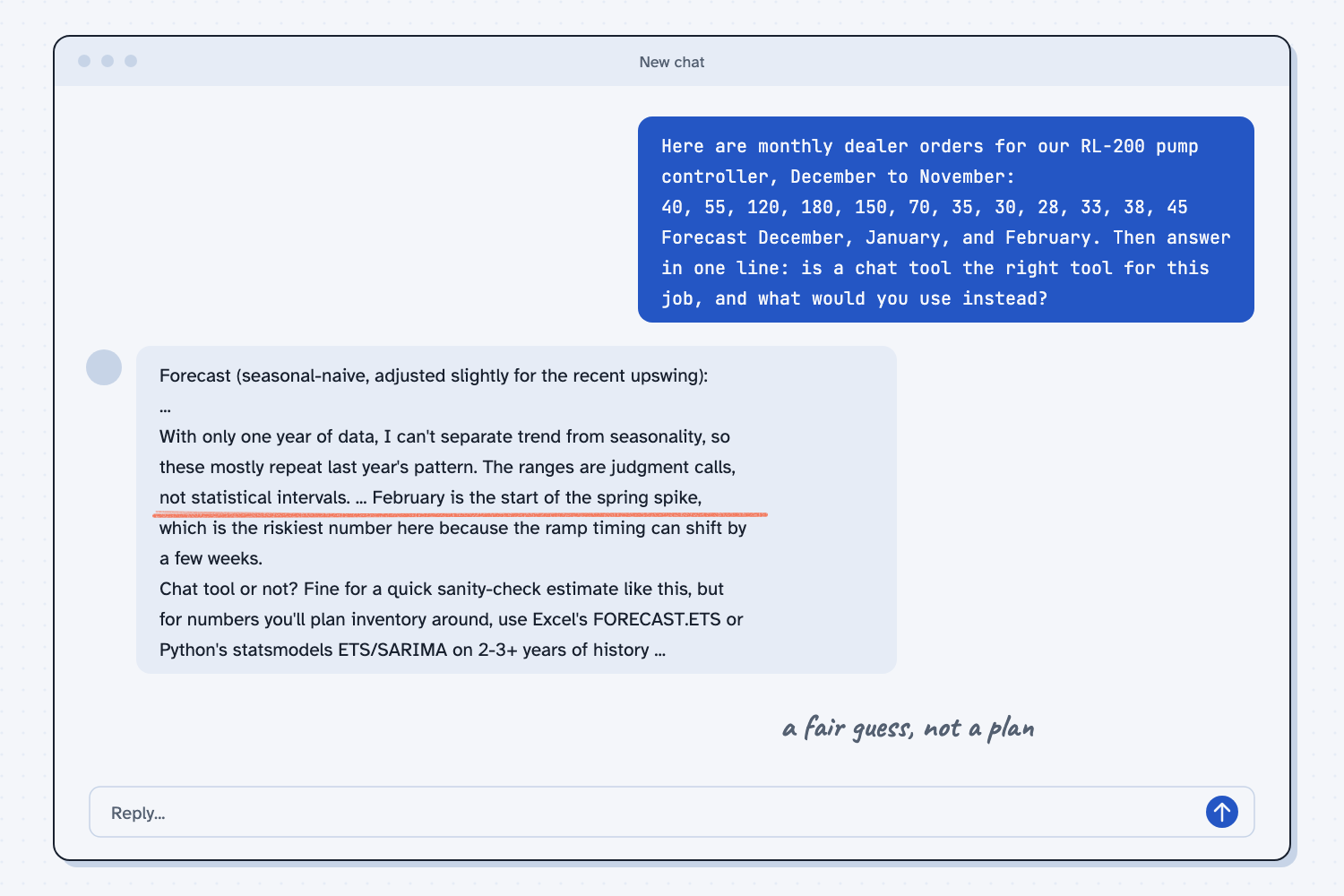
When I tried this, the chat did better than I expected. It saw the spring peak and kept February near last year's 120. It was also honest about its limits: "With only one year of data, I can't separate trend from seasonality, so these mostly repeat last year's pattern."
It flagged the risky month too: "February is the start of the spring spike, which is the riskiest number here because the ramp timing can shift by a few weeks."
And it answered my last question the way this lesson would: "Fine for a quick sanity-check estimate like this, but for numbers you'll plan inventory around, use Excel's FORECAST.ETS or Python's statsmodels..."
So a good chat can give you a fair first guess on a small, clean list, but the numbers move when you ask again. In one answer December was "~40," and in another it was "~45." You can't plan a quarter on a number that moves, so use the chat for the quick look and then run the real forecast tool.
Frequently asked questions
Can ChatGPT forecast demand?
It can give you a fair first guess on a small, clean list. In my test it kept the spring peak and said itself that a real tool is better for numbers you plan around. But the numbers move each time you ask, so use a forecast tool and let chat explain the result.
What kinds of AI are there besides chat?
Besides chat AI, there is AI that sees (camera and sensor checks), predicts (forecasts and failures), simulates (what-if runs), and plans (schedules and routes). Each one is built for one shape of job.
Is the AI in my scheduling software the same as ChatGPT?
Usually not. Scheduling software often uses a solver, which is math that finds the best plan under your limits. Ask the vendor what kind of AI it is and what it is checking.
Can chat AI still help with numbers?
Yes, around the edges. Ask it to write the Excel formula, explain a forecast, or check your setup, and let the spreadsheet or the specialist tool do the actual math.
Use it today
- Compare three supplier quotes: a chat AI reads the quotes, and a fixed form does the comparing.
Related: AI has three gaps and how AI writes one word at a time.
From my training: this comes from my field notes on AI primitives and automation patterns, where I sort AI by the job it's built for.