How to Teach AI Your Judgment: Write Down Why
With Josh Schultz ·
Answer. To teach AI your judgment, write down why you made a call, not just what you did. A short note with the situation, the options, your choice, and your reason is called a decision trace (a record of why). When you give AI a few of those notes, it starts deciding the way you would.
The picture
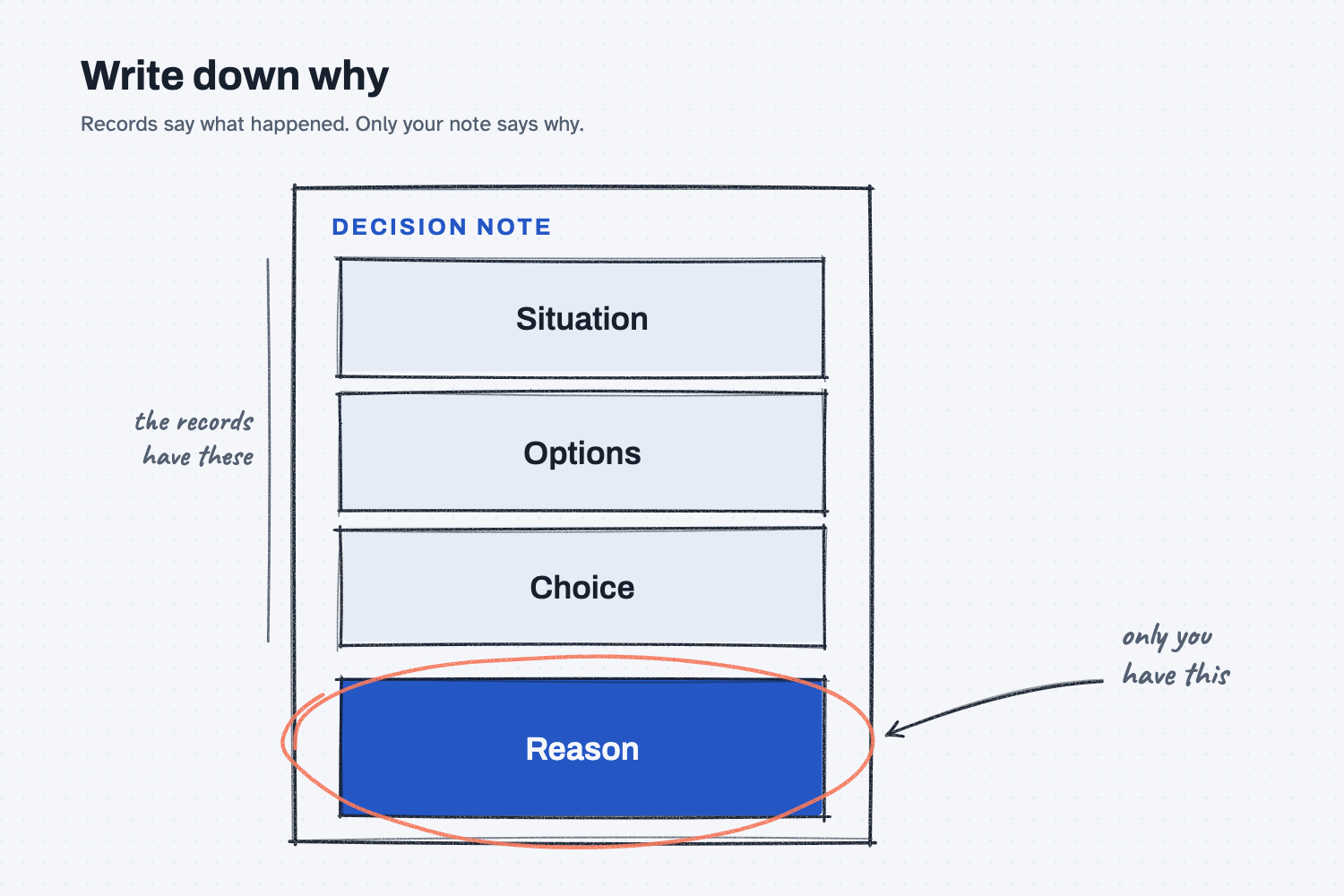
The picture shows a note card with four rows: situation, options, choice, and reason. Your ERP already knows the first three rows, more or less, because it recorded that the order was late and what you did about it. The last row, the reason, lives only in your head, and that is the row AI needs most.
Think of it like this
Think of a job traveler, the paper that follows a job around the shop floor, coming back with a note written in the margin. The printed part says what happened: the job started Tuesday, finished Friday, and ran 4 days late.
The margin note says why. "Held it on purpose. Had slack. Didn't want to pay the rush fee."
A new planner who reads only the printed part learns nothing about how the shop thinks. A new planner who reads the margin learns the reasoning, so next time they can make the same call without asking.
AI is that new planner. It can read every printed record you have, but it has never seen the margin notes, because almost nobody writes them.
Why does it matter at work?
Records tell AI what is true, but they do not tell it what to do, and what to do is where your experience lives. As I put it in my framework notes: "When the person who made the call leaves, the reasons leave with them."
Here is an example. Hector Lee, the production planner at Mesquite Ridge Metal Works, makes the expedite calls, so he knows when to pay a rush fee and when to shuffle the schedule instead. None of that is written down.
When Hector goes on vacation, Dana Ortiz covers for him. A supplier is late on plate for a bracket order, so Dana asks AI what to do. She gets a sensible answer, but it rests on a rule AI made up rather than on Hector's rule, so it is helpful without matching how the shop decides.
Before his next trip, Hector writes three short notes about his last three expedite calls. Now when Dana pastes one in along with the new case, the answer comes back with Hector's rule attached.
How does it work?
You write each note in the same shape, and then you hand AI a few notes along with the new case.
The four rows. Situation is what happened and what it forced. Options are the choices on the table. Choice is what you picked. Reason is why you picked it, in your own words, and later you can add a fifth row for the outcome.
The reason row matters most. It is also the one people skip, because it takes a moment of thought. As I wrote in my notes: "The reason field is the one most teams skip and the one that matters most. Without it, you have a log. With it, you have the start of identity."
Start with one kind of decision. You do not need to write down every call you make, so choose one kind and begin there. The picture below lists four checks for choosing it.
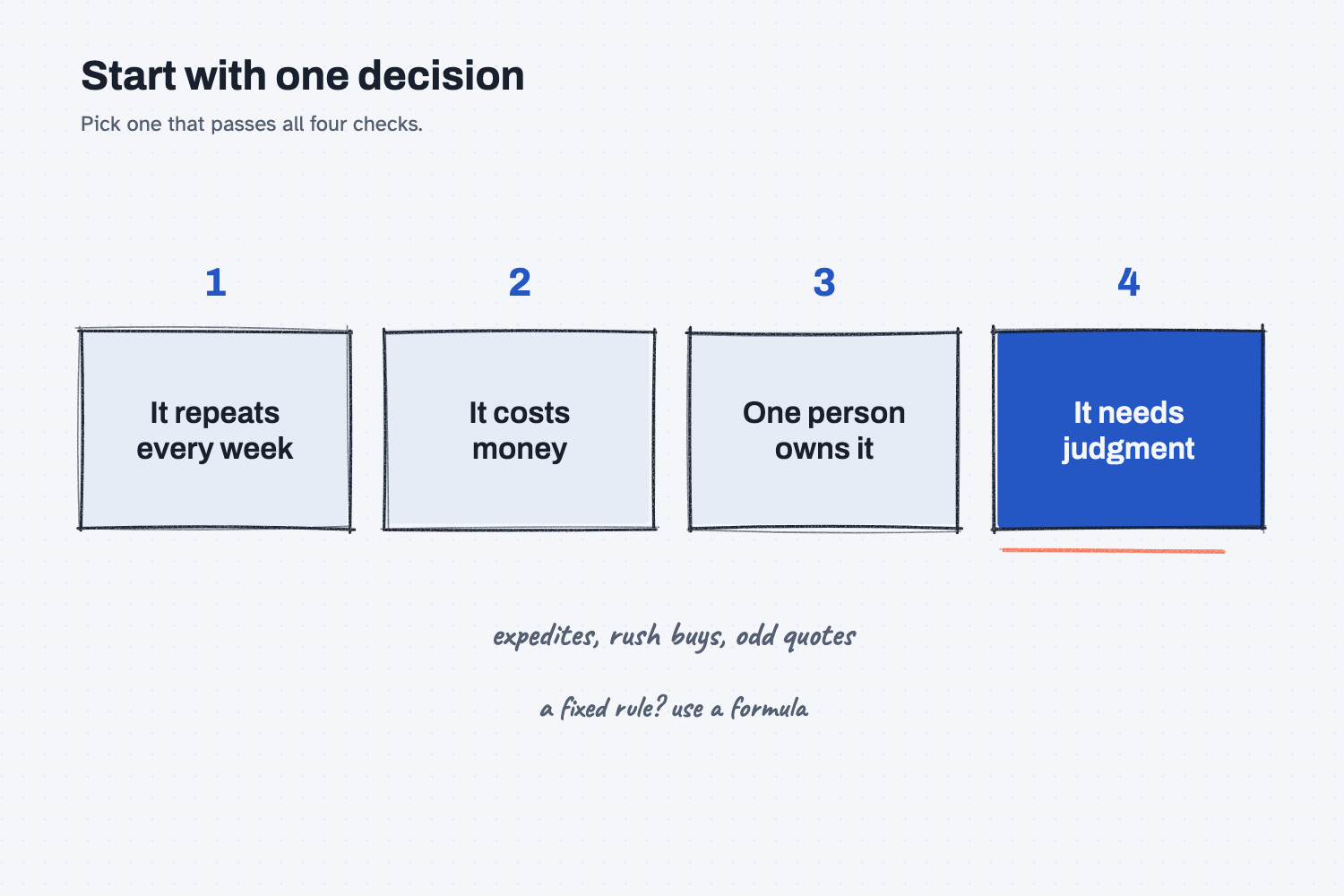
Pick a decision that repeats every week, costs money when it goes wrong, has one clear owner, and needs judgment. Expedites, rush buys, and quotes on odd jobs are good first picks. If a fixed rule already handles the decision, you do not need a note, because a simple formula will do the job.
For calls already made, walk back through them. Sit down with the person who makes the call, and ask what they looked at, what else they considered, and why they picked what they picked.
Where do people get it wrong?
Most mistakes come from writing down the "what" and stopping there. These are the four I see most often.
- Writing only what happened. "Paid the rush fee" teaches nothing, while "Paid it because the customer's line was down" teaches a rule.
- Starting with a rare decision. A call you make once a year will not give you enough notes to see a pattern, so start with something that happens weekly.
- Writing an essay. Five lines is plenty, because if a note takes ten minutes nobody will keep doing it.
- Letting AI make the call alone. The note helps AI suggest what you would do, but a person should still check and decide, at least until it has earned more trust.
Try this in 2 minutes
This test asks the same question twice, once without a note and once with one, and you can use any chat tool.
- Open a new chat and paste only the new case:
New case: Panhandle Bar and Plate is 5 days late on the A36 plate for a Tri-County Implement bracket order. The order has 6 days of slack before its ship date. Panhandle can rush it for a $1,200 fee, or I can move up another job and run the brackets later.
What would I do? Answer in 3 short lines.
- Open a second new chat. Paste the note first, then the same case:
Here is how I made a call last month.
Situation: Red Creek Steel was 4 days late on 4140 bar stock for a Prairie Wheel shaft order.
Options: pay Red Creek $1,800 to rush it, buy from Panhandle, or move up another job and run the shafts later.
Choice: moved up the manifold job and ran the shafts 4 days later. No rush fee.
Reason: the order had 5 days of slack. We only pay rush fees when a customer's line is down or there is no slack left.

New case: Panhandle Bar and Plate is 5 days late on the A36 plate for a Tri-County Implement bracket order. The order has 6 days of slack before its ship date. Panhandle can rush it for a $1,200 fee, or I can move up another job and run the brackets later.
What would I do? Answer in 3 short lines.
- Put the two answers side by side.
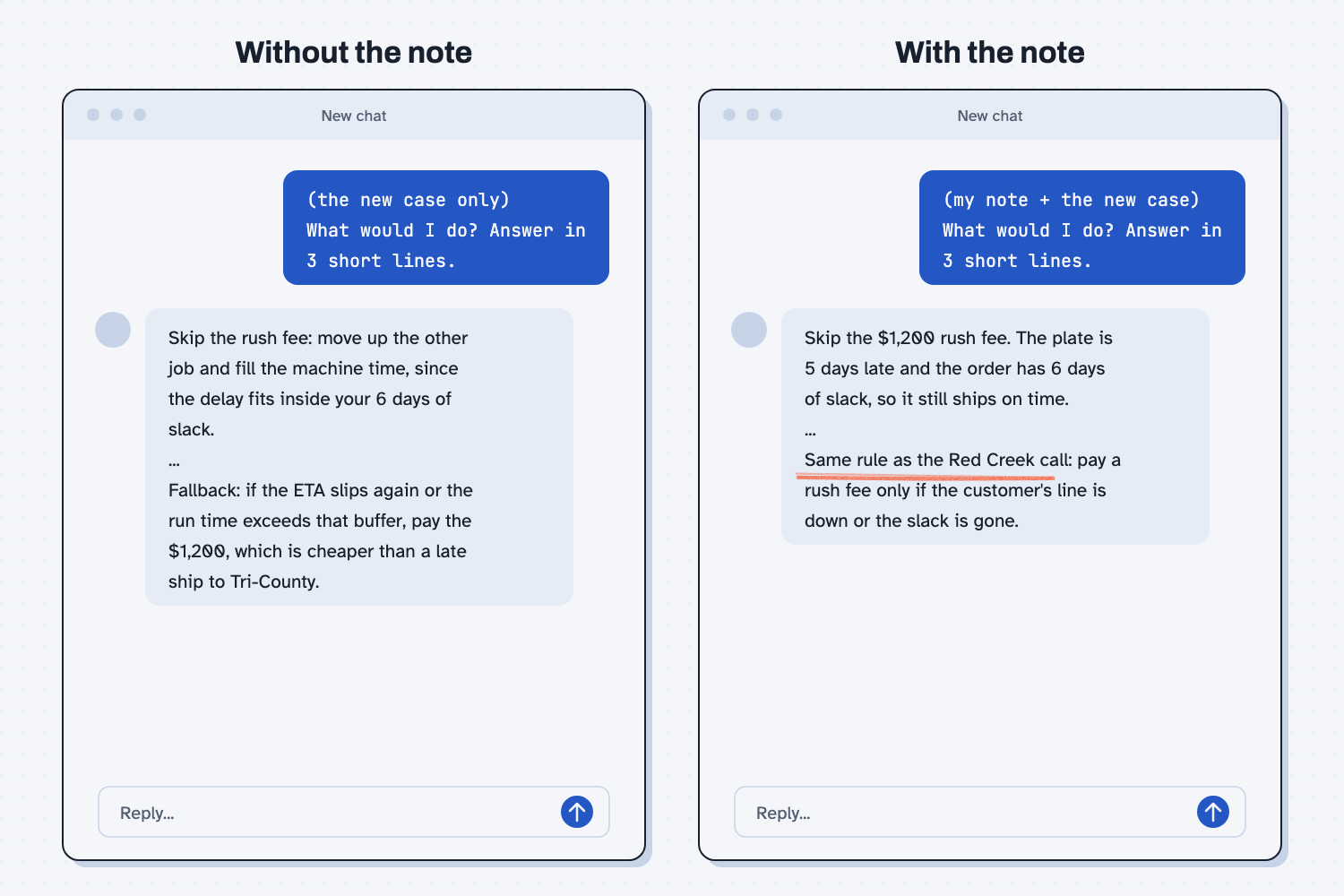
When I tried this, the case was easy enough that the AI made the same call both ways, which was to skip the fee and move up another job. What changed was the reason it gave.
Without the note, it made up its own rule. It said: "Skip the rush fee: move up the other job and fill the machine time, since the delay fits inside your 6 days of slack." Then it added: "if the ETA slips again or the run time exceeds that buffer, pay the $1,200, which is cheaper than a late ship to Tri-County."
With the note, it used my rule. It said: "Same rule as the Red Creek call: pay a rush fee only if the customer's line is down or the slack is gone."
The case was the same in both chats, and the only difference was one five-line note, which was enough to make the answer follow my rule instead of a generic one. If you try a case where your rule and common sense disagree, the gap will be even bigger.
Frequently asked questions
What is a decision trace?
A decision trace is a short record of one decision: the situation, the options, the choice, and the reason. You can add the outcome later. It is a way to write down judgment so a new person, or AI, can learn it.
Where do I keep my notes so AI can use them?
Put them in a document you paste in, or in a project so every chat starts with them. The lesson on how to stack context for AI shows where they fit.
How many notes do I need?
Start with three to five for one kind of decision, which is enough to see whether the answers start to sound like you. After that, add one each time you make that call.
Isn't this just writing an SOP?
It is close, but not the same. An SOP says what to do when the rules are clear, while a decision trace captures what you did when the rules ran out, and why.
Use it today
Related: Tell AI what wins when two goods clash covers the priorities behind your reasons.
From my training: this comes from my framework on how companies can capture the way they make decisions, not just their data.